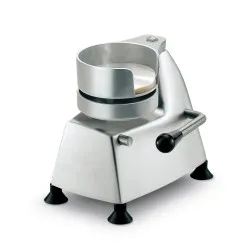
Hamburger presses for professional kitchens
Hamburger presses help foodservice operations control portion size, maintain uniform patty dimensions and streamline work during peak hours. Restaurants, burger bars and quick-service outlets can reduce manual work and minimize inconsistencies, as each patty is pressed to an identical diameter and thickness. Professional presses commonly shape patties of 100, 130 or 150 mm, and some models allow thickness adjustment within approximately 5–18 mm.
In a HoReCa environment, portion accuracy influences both cost control and service speed. Hand-formed patties often differ in weight and density, while a press ensures uniform mass and predictable cooking time. Many models use paper sheets, allowing patties to be stacked and separated easily.
Types of hamburger presses
Professional kitchens most often use manual lever-operated hamburger presses. The operator fills the forming chamber with minced meat and presses it to a uniform thickness using the lever. Some devices include integrated meat containers, which enable sequential preparation without refilling each portion manually.
Many models combine an anodised aluminium body with a stainless steel forming tray and pressure plate. Aluminium reduces overall weight and simplifies handling, while stainless steel provides durability and hygiene in food-contact areas. Some solutions include food-grade plastic components that are easy to clean and do not absorb odours.
Available models cover different diameters — 100 mm, 130 mm and 150 mm — suitable for various burger styles. Diameter and thickness influence portion weight and cooking time, which is important both for classic burger bars and venues preparing mini or oversized burgers.
What to check before purchasing
The choice of hamburger press depends on the burger style and daily production volume. Standard burgers typically use 100–130 mm presses, while larger formats require 150 mm models. Thickness adjustment is especially important, as it determines portion weight and cooking behaviour.
- Patty diameter and thickness adjustment range suited to the menu.
- Body and food-contact materials such as stainless steel and anodised aluminium.
- Weight and dimensions for convenient placement and handling.
- Ergonomics of the lever mechanism for long working hours.
- Availability of paper discs for easier forming and storage.
Output capacity is another key factor. Although manual presses can produce many patties quickly, actual speed depends on staff skills and workflow. High-volume operations may prefer more robust models with stronger mechanisms and larger meat containers.
Use and maintenance
To ensure safe operation, the press should be placed on a stable surface and checked for secure footing. Manufacturers usually advise against applying excessive force or submerging the device in water if it contains mechanical components.
Daily cleaning involves disassembling the parts intended for washing and cleaning surfaces with warm water and mild detergents. Regular cleaning prevents fat and protein buildup, which affects hygiene and forming quality.
Certain components made of cast iron or coated materials require gentler care. Light lubrication with food-safe oil may help reduce sticking and protect surfaces from wear.
Paper separators are often used to simplify patty removal and storage. Even when using paper, the press must be cleaned and disinfected regularly to maintain professional hygiene standards.
BHS service
BHS supplies professional HoReCa equipment and assists in selecting a suitable hamburger press based on workload and existing kitchen equipment. Presses can be matched with meat grinders, refrigeration units and dishwashing systems for an efficient workflow.
BHS provides spare parts for various kitchen appliances, including meat processing equipment, thermal equipment and dishwashing machines, helping businesses keep equipment operational in the long term.
BHS technical support offers guidance on installation, use and workflow optimisation to help kitchens fully benefit from hamburger presses.
Frequently asked questions about hamburger presses
What patty diameter should I choose?
Diameter is usually chosen based on the menu. Standard burgers commonly use 100–130 mm presses, while larger burgers require 150 mm models.
What is the difference between manual and semi-automatic presses?
Manual presses operate with a lever and suit most kitchens, while semi-automatic models support high-volume work with reduced operator effort.
Can the press form patties from other mixtures besides beef?
Many presses can shape chicken, fish, vegetable and vegan patties if the mixture is uniform and suitable for pressing.
How should a hamburger press be maintained?
It should be cleaned, disinfected and dried regularly. Food-contact surfaces are washed with mild detergents, avoiding metal scrapers and aggressive chemicals.
How does BHS service support long-term equipment maintenance?
BHS provides spare parts, consultations and technical support to help maintain hamburger presses and other kitchen equipment long term.